


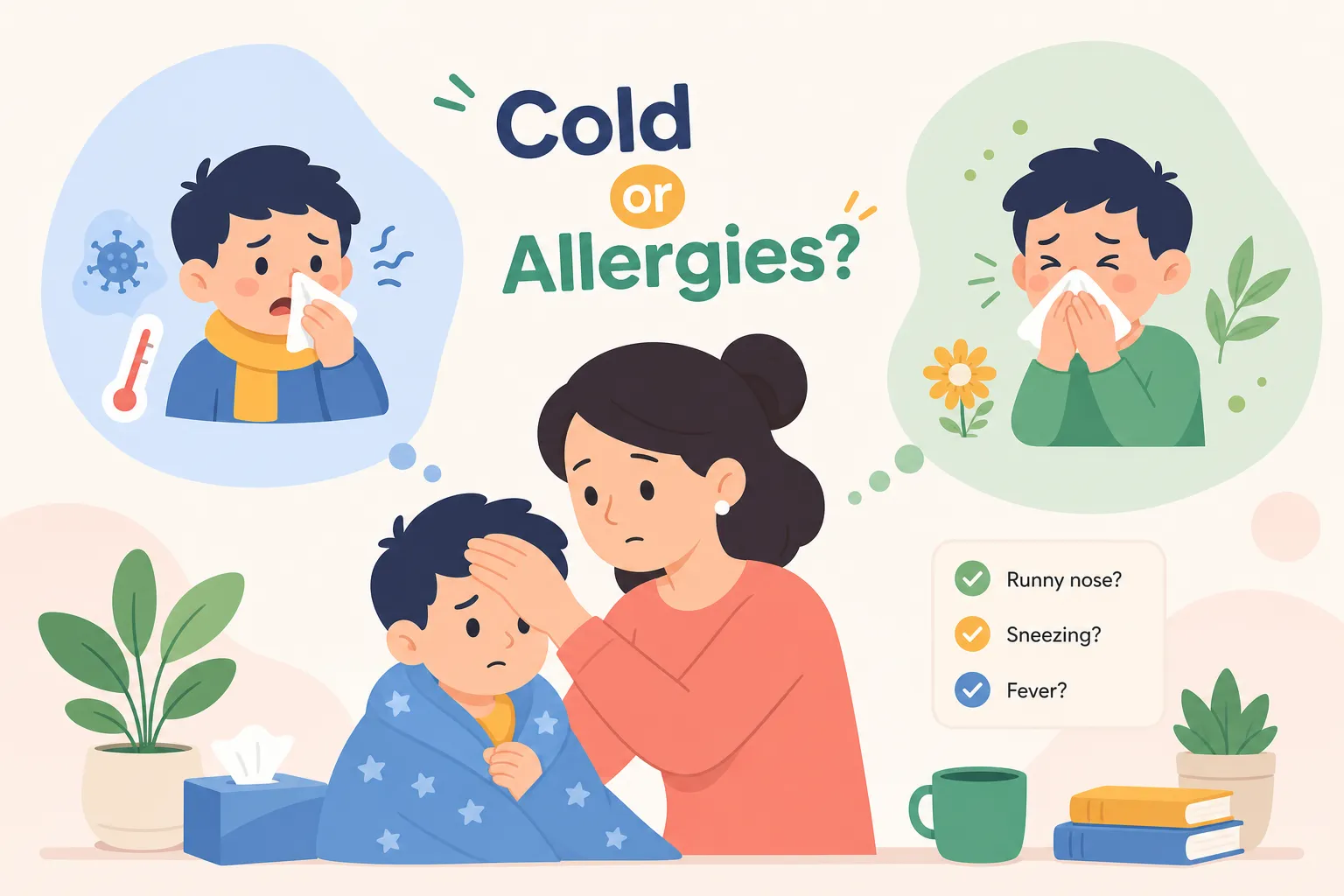
Your child wakes up with a runny nose, sneezing, and eyes that won’t stop watering. You’re standing in the kitchen asking yourself: Is this a cold or allergies? Symptoms of cold vs. allergies in kids can be confusing even to seasoned parents, especially when seasons change and pollen counts are rising in North Georgia.
This is a question Dr. Akbar is asked all the time by families at YouBelong Pediatrics — and there is a practical way to work through it at home. This article gives you a clinical framework, five symptom clues, a quick checklist, age-appropriate home care steps, and clear guidance on when a same-day sick visit is the smarter route to answers.
Cold vs. Allergies in Kids: The 5 Symptom Clues That Count
The vast majority of parents see a runny nose and stop there. The nose alone is a very poor guide. These five clues combine to form the real diagnostic picture.
1. Fever Is a Sure Divider
If your child has a fever, that is a strong indicator of a viral infection — not allergies. Allergic rhinitis is an immune response to a trigger such as pollen or pet dander, and that type of reaction does not cause the temperature elevation that a viral infection does. Fever is the body’s way of fighting off a pathogen. With allergies, temperature stays normal throughout.
2. Itchy Eyes and Sneezing Fits Point to Allergies
Red, itchy, watery eyes are a hallmark of allergic rhinitis and are rarely a feature of the common cold. If your child is constantly rubbing their eyes, that is one of the most useful parent-observable clues you have. The pattern of sneezing also matters: allergies typically produce rapid, repetitive bursts, while a viral cold causes more scattered, occasional sneezes with longer pauses in between.
3. What Mucus Color and Consistency Really Mean
Clear, thin, watery mucus is more characteristic of allergies. Clear mucus that thickens and turns yellow or green over a few days is more typical of a viral cold. This is where many parents go wrong: yellow or green mucus does not necessarily indicate a bacterial infection requiring antibiotics. That color change is a normal part of the immune system clearing a viral illness. Mucus color alone is not a reason to request antibiotics.
4. Duration: How Long Symptoms Last
A viral cold follows a predictable arc: symptoms begin 1–3 days after exposure, worsen around days 3–4, then gradually improve from day 5 onward. Most colds resolve within 7–10 days. Allergy symptoms, by contrast, persist as long as the child is exposed to the trigger — potentially weeks during North Georgia’s peak tree pollen season (late March to mid-April), grass pollen season (late May to June), or ragweed season (through September). A “cold” still going strong after 10–14 days with no fever and no arc of improvement is a strong signal to reassess.
5. Timing and Seasonal Pattern
Timing is one of the strongest — and most underused — diagnostic clues parents have. A typical allergy pattern involves symptoms that flare at the same time each year, particularly in spring or late summer. If your child’s “cold” comes back every April or every September, seasonal allergies deserve a conversation with your pediatrician.
A Checklist for Parents: Cold vs. Allergies in Children
Look at these two groups of symptoms and decide which list best fits your child. You don’t need to match every item — you are looking for the overall weight of the picture. If you are still unsure after this checklist, our Is My Child Sick? resource can help you decide your next step.
Signs of a Cold
- Fever present at any point
- Symptoms developed suddenly after contact with a sick child or crowd
- Sore throat (real pain, not just mild scratchiness)
- Mucus initially clear, then thickened and changed color after a few days
- Child is unusually tired or more clingy than usual
- Symptoms clearly improved by day 5–7
Signs of Allergies
- Eyes are itchy, watery, or red — child rubs them frequently
- Sneezing occurs in rapid-fire bursts
- Mucus stays clear and watery without thickening
- No fever at any point during the illness
- Symptoms began during a particular season or after extended time outdoors
- Symptoms improve indoors and worsen outdoors
What to Do If You Check Boxes on Both Lists
Overlap is real and not rare. A child can have both a viral cold and seasonal allergies at the same time — especially in autumn when ragweed peaks just as school-age children return to classrooms and swap germs. But if there is a fever, that strongly tips the odds toward a viral illness, regardless of what else is on the list. That is when a pediatrician visit is more valuable than guessing at the pharmacy counter.
Safe At-Home Steps While You Watch and Wait
Knowing which way symptoms lean helps you choose the right supportive care. What actually works depends on how old your child is and what condition you are treating.
Managing Cold Symptoms at Home
| Age Group | Recommended Home Care | Key Cautions |
|---|---|---|
| Infants & toddlers under 2 | Saline nasal drops; bulb syringe or nasal aspirator; cool-mist humidifier; age-appropriate fever management | Do not give acetaminophen to infants under 3 months without calling your pediatrician. Do not use OTC cough & cold medicines under age 2. Many labels now carry warnings for children under 4. |
| Infants 3 months and over | Acetaminophen by weight for fever management (ask your pediatrician for the correct dose) | Do not use acetaminophen in infants under 6 months unless instructed by a clinician. |
| School-age children | Acetaminophen or ibuprofen for fever/discomfort; saline rinses; honey for mild cough (children over 1 year only); rest and fluids | Evidence for OTC cough-and-cold combinations is limited; most pediatric guidelines do not recommend them routinely due to side-effect risk. |
For practical guidance on over-the-counter medicines, see Medicine Dosages at YouBelong Pediatrics.
Managing Allergy Symptoms at Home
For children age 2 and older, a non-sedating antihistamine is a reasonable first step:
- Cetirizine (Zyrtec): 2.5 mg once daily for ages 2–5
- Loratadine (Claritin): 5 mg once daily for ages 2–5
Formulations vary — always dose according to the child’s age and weight using the specific product label. Consult your pediatrician before giving any antihistamine to children under 2, as OTC age approvals are not uniform across products.
Environmental steps make a real difference too:
- Limit outdoor time when pollen counts are highest (typically morning hours)
- Keep windows closed during high-pollen periods
- Have your child shower after playing outside to wash pollen off skin and hair
Red Flags: When Your Child Needs to Be Seen Today
Most colds and allergy flare-ups can be managed at home. But some symptoms require urgent assessment — no wait-and-see approach.
⚠ Seek Same-Day or Emergency Care for These Symptoms
- Breathing fast, hard, or noisily, or blue color around the lips or face — call 911 or go to the ER immediately; do not wait for a pediatric office visit
- Chest retractions or wheeze with obvious effort to breathe
- Fever in any infant under 3 months of age at any temperature ≥100.4°F
- Very high fever lasting more than 4–5 days, or fever that returns after initially improving — contact your pediatrician or refer to AAP age-specific fever guidelines
- Signs of dehydration: dry mouth, no tears when crying, or very little urine output
- Unusual behavior — hard to wake up, confused, or not responding normally
When a Same-Day Sick Visit Is Better Than Urgent Care
When you are not sure whether your child has a cold or allergies — or the symptoms don’t neatly fit either — a same-day sick visit with your pediatrician provides something urgent care usually can’t: continuity of care. Your child’s pediatrician knows their medical history, the pattern of past illnesses, and what is normal for them. That context makes a meaningful difference in the quality of the diagnosis.
Dr. Akbar and the team at YouBelong Pediatrics offer same-day sick visit appointments for exactly this type of situation. You receive a diagnosis based on your child’s entire history — not a symptom checklist reviewed by someone meeting them for the first time. Getting the answer right the first time means faster relief and no wasted time on the wrong treatment.
When to Ask About Allergy Testing or a Specialist Referral
For many families, the checklist and home care approach is sufficient. But knowing when to escalate the conversation is part of good long-term care.
Signs That Recurring Allergy Symptoms Need More Than Home Management
- Significant nasal and eye symptoms during the same season two years in a row
- Symptoms are causing your child to miss school
- Sleep is disrupted
- No adequate relief from OTC antihistamines
- Possible overlap with asthma triggers — wheezing or a chronic cough that worsens outdoors
These are reasons to have a dedicated allergy conversation at your child’s well-child visit rather than continuing to manage symptoms reactively.
What Allergy Testing in Children Is Really Like
There are two main types of allergy testing for kids:
- Skin prick testing: Results are available in 15–20 minutes at the time of the visit. Generally most reliable from age 2 and considered the more sensitive choice for children who can cooperate with the test.
- Serum-specific IgE blood testing: Can be performed at any age, even in infancy. Does not require stopping antihistamines before the visit. Preferred for younger children, those with significant eczema, or those on medications that would interfere with skin testing.
One important point from AAP guidelines: targeted testing based on the child’s specific history produces better results than broad allergy panels. Unselective panel testing creates false positives and can lead families down unnecessary treatment paths.
Referral to a board-certified allergist is appropriate if symptoms are recurrent and substantially affect quality of life, or if any reaction has involved difficulty breathing, throat tightness, or swelling. That referral conversation always starts at primary care. At YouBelong Pediatrics, it is embedded in the context of your child’s whole health picture.
Putting It All Together
The framework is simpler than it feels in the moment:
- Fever = viral cold until proven otherwise
- Itchy eyes + sneezing fits without fever = allergies are more likely
- Duration is the most underused clue parents have: a cold resolves in 7–10 days with a clear arc; allergies last for weeks, recur at the same time each year, and improve indoors
Running through the checklist is a completely acceptable outcome — including an overlapping or uncertain picture. Some clinical situations genuinely need a trained eye and your child’s history to sort out accurately. You have not missed anything obvious.
Not Sure? Get the Right Answer the First Time.
Dr. Akbar and the YouBelong Pediatrics team offer same-day sick visit appointments for families in Suwanee, Cumming, Johns Creek, and surrounding North Georgia communities. A diagnosis based on your child’s full history — not a first-time symptom checklist.
Book a Same-Day Appointment
Or call us at (770) 585-0190 · 3525 Lawrenceville-Suwanee Rd, Suite 101, Suwanee, GA 30024

About Dr. Rabia Akbar, MD
Board-Certified Pediatrician · Advanced Training in Pediatric Critical Care · 20+ Years of Experience · YouBelong Pediatrics, Suwanee, GA
Dr. Rabia Akbar is a warm and experienced pediatrician in Suwanee, Georgia with over 20 years of experience in pediatric medicine and critical care. She is board-certified and deeply believes that every child deserves gentle, thoughtful care tailored to their individual history.
As a mother of three — including two children born prematurely — Dr. Akbar understands firsthand the worries and fears that new and experienced parents face, and she brings that empathy to every visit. She leads a multilingual team at YouBelong Pediatrics serving families in English, Arabic, Spanish, Hindi, Urdu, and Punjabi.
YouBelong Pediatrics is proudly women-owned and operated, serving Suwanee, Cumming, Johns Creek, and surrounding Gwinnett County communities. New patients are welcome.
Medical Disclaimer: This article is written and reviewed by a board-certified pediatrician and is intended for general educational purposes only. It does not constitute medical advice, diagnosis, or treatment. Always consult your child’s healthcare provider with questions about a specific medical condition. If your child is experiencing a medical emergency, call 911 immediately.