




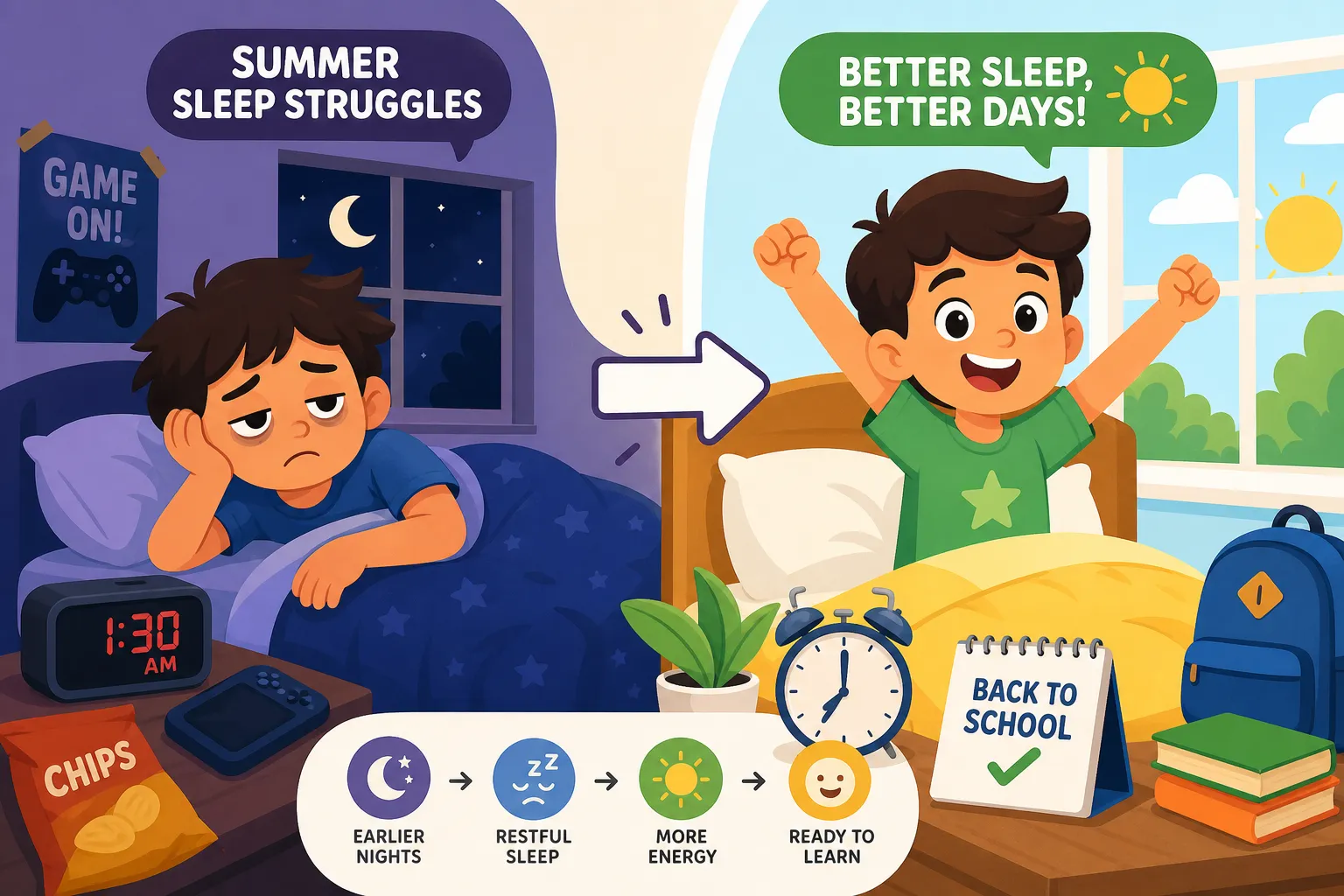
School is out, the pressure is off, and suddenly late bedtimes feel harmless. The children are happy. Summer is long. You tell yourself you will handle it in August. This is exactly what most parents do — and it is completely understandable. But letting your child’s sleep schedule slip over summer does not just mean rough Monday mornings in September. Follow this guide to reset Summer Sleep Schedule for Kids before school starts.
A one- to two-hour shift from a child’s school-year pattern can compound over weeks into moodiness, attention problems, a weakened immune system, and emotional meltdowns that parents chalk up to “summer restlessness.” The real culprit is almost always sleep.
This guide gives you age-by-age sleep targets, sample daily schedules, a realistic step-by-step plan to reset your child’s sleep before summer ends, and the signs that tell you it is time to call your pediatrician.
How Much Sleep Does Your Child Really Need This Summer?
The American Academy of Sleep Medicine (AASM) and the American Academy of Pediatrics (AAP) recommend the following sleep ranges for children. These apply year-round — summer does not change how much sleep a growing brain and body needs to function well.
| Age Group | Recommended Sleep | Notes |
|---|---|---|
| Infants (4–12 months) | 12–16 hours | Includes naps; separate guidance applies to newborns in first 6 months |
| Toddlers (1–2 years) | 11–14 hours | Includes naps |
| Preschoolers (3–5 years) | 10–13 hours | Includes naps where still occurring |
| School-age (6–12 years) | 9–12 hours | No naps; protected wind-down time important |
| Teenagers (13–18 years) | 8–10 hours | Puberty delays melatonin release; early wake times are the key lever |
Why Sleeping In Won’t Make Up for Lost Nighttime Hours
Many parents reason that if a child stays up until midnight but sleeps until 10 a.m., the total hours add up. Research in sleep physiology shows otherwise. The body concentrates deep, restorative slow-wave sleep — the stage where the most important neural repair and memory consolidation occurs — in the first half of the night. Morning sleep is lighter and does not do the same work.
Studies on circadian disturbance in school-aged children suggest that the effects of persistent schedule drift can persist for several weeks after the school year begins. A child who starts class in August or September may still be functioning on an impaired baseline well into the first month of school.
Why Summer Disrupts Kids’ Sleep
Later Sunsets and Your Child’s Internal Clock
The circadian rhythm uses light cues to know when to release melatonin — the hormone that signals the body to prepare for sleep. During summer in many parts of the U.S., sunset does not come until 8:30–9:00 p.m. or later, which pushes the melatonin signal back considerably. The child who normally falls asleep at 7:30 p.m. in March cannot recreate that feeling in June when it is still light outside. This is a biological response, not a behavioral one. If your child tells you they are not tired at 8 p.m. in July, they are almost certainly being truthful.
Screens, Blue Light, and Melatonin Suppression
Light from screens suppresses melatonin far more in children than in adults. Research has found that two hours of tablet exposure is linked to a significant reduction in melatonin and a notable delay in its onset compared with reading a printed book in low light. Longer summer days mean more screen time in the evening, which compounds the melatonin delay already caused by late sunsets — the two problems are mutually reinforcing.
Practical rule in line with AAP guidance: No screens in the one to two hours before bedtime, and devices out of the bedroom. Begin enforcing this screen curfew one to two weeks before the schedule-shift period begins so it becomes habit first. For full AAP guidance on healthy digital habits, see Healthy Digital Media Use Habits for Children.
What Sleep Deprivation Really Does to Kids Over Summer
Mood Changes, Attention Problems, and Behavior Changes
The behavioral signs of insufficient sleep in children often look like something else. Irritability, emotional meltdowns, low frustration tolerance, difficulty focusing, and outbursts that seem disproportionate to the situation are a classic presentation of a child running on suboptimal sleep. Sleep is when the brain processes what has been learned and regulates emotional responses — cutting it short impairs the brain’s ability to handle stress and stay focused. Research also confirms that regular bedtimes are associated with better child emotion and behavior, which is a reminder that routine still matters even in summer.
Sleep deprivation — even slight — worsens symptoms in children with existing ADHD or anxiety. A child who is well managed during the school year can become much more difficult to support at home by mid-July simply because the sleep foundation has eroded. This is a physiological result, not a parenting failure.
The Immunity Link Most Parents Miss
The immune system relies on regular, adequate sleep to produce cytokines and carry out tissue repair. Research suggests children who chronically undersleep show decreased natural killer cell activity, altered immune response, and potentially decreased antibody production following vaccination. The Sleep Foundation outlines in detail how chronic sleep deprivation affects immune stem cells and increases susceptibility to respiratory infections, colds, and flu.
A child who begins September sleep-deprived starts school with a diminished capacity to fight off the infections that circulate through any classroom in the first weeks of the year. At YouBelong Pediatrics, we see this connection between summer sleep habits and early autumn illness reflected clearly in the pattern of sick visits each fall.
Sample for Summer Sleep Schedule for Kids, by Age
Ages 1–3: Toddlers
- Wake: 7:00–7:30 a.m.
- Nap: Approximately 12:30–2:30 p.m. — nap must end no later than 3:00 p.m.
- Bedtime: 7:00–7:30 p.m.
- Total sleep: 12–14 hours across the day
The end time of the nap is as important as the start time. A nap that extends to 4:30 p.m. will almost always push bedtime to 9:00 p.m. or later.
Ages 3–5: Preschoolers
- Wake: 7:00–8:00 a.m.
- Midday: Short nap or 45 minutes of quiet, screen-free time after lunch
- Bedtime: 7:30–8:00 p.m.
Many 4- and 5-year-olds have given up napping. Replace the nap with quiet time rather than eliminating the rest period entirely. If your child still naps at this age, end it by 3:00 p.m. to preserve the nighttime sleep window.
Ages 6–12: School-Age Children
- Wake: 7:30–8:30 a.m.
- Afternoon: Outdoor activity or physical play
- Wind-down: Consistent 30–45 minute screen-free routine before bed
- Lights out: 8:00–9:00 p.m.
- Total sleep: 9–12 hours
A common trap at this age: children feel fine in the moment on less sleep. A child who seems “fine” on 8 hours may function noticeably better on 10. On late activity nights, keep wake time within 30–45 minutes of normal rather than allowing both bedtime and wake time to slide — this single habit does more to protect a child’s summer sleep schedule than almost anything else.
Ages 13–17: Teenagers
- Wake: No later than 9:00–9:30 a.m.
- Naps: None
- Screens off: By 9:30 p.m.
- Lights out: 10:30–11:00 p.m.
- Total sleep: 8–10 hours
Puberty biologically delays melatonin release, so teens genuinely feel tired later than younger children — this is developmental, not defiance. However, sleeping until noon every day in June and July creates a circadian shift that takes weeks to reverse. Teens are the group most likely to experience severe summer drift, and they need the longest transition runway before school begins. The CDC notes that adolescent circadian patterns are a key factor in school start time discussions for exactly this reason.
How to Reset Your Child’s Sleep Schedule Before School Starts
When to Start and How Fast to Move
How far to shift depends on how far off schedule your child has drifted. If your child is more than one to two hours off their school-year bedtime and wake time, begin the transition two to three weeks before school starts. If the drift is small — 30 to 45 minutes — a week of gradual shifting usually does it.
The most effective approach is to move the wake time earlier first, not force an earlier bedtime. As the wake time moves forward, sleep pressure builds earlier in the day and the earlier bedtime becomes genuinely achievable rather than forced.
- Begin the screen curfew one to two weeks before the schedule shift starts so it becomes habit first — not a simultaneous change.
- Move wake time 15 minutes earlier every 2–3 days. For teenagers, use 10-minute increments and start at least three weeks out. Do not expect a teenager to go to bed at 10:00 p.m. on the first night of the transition — it will not stick.
- As soon as the child wakes at the new time, get them outside or open the curtains immediately. Morning light is one of the most powerful and free circadian tools available. It strengthens the new wake signal and helps the body adjust its melatonin schedule faster.
- During the transition, limit naps for younger children to 90 minutes, ending no later than 2:30–3:00 p.m. A late nap during the shift period can undo several days of bedtime progress in one afternoon.
- Hold the new wake time on weekends too. Sleeping in by even 90 minutes on Saturday can push the child’s schedule back significantly and feel like starting over. Stick to the target for the first few weeks, even if it is uncomfortable.
For a deeper look at pediatric sleep hygiene and sleep reset strategies, the Boston Children’s Hospital Sleep Center provides comprehensive guidance on sleep schedules for children and adolescents.
When to Talk to Your Pediatrician About Sleep
Signs a Child’s Sleep Issues Go Beyond Summer Schedule Drift
- Cannot fall asleep despite a well-managed environment and consistent routine
- Snores loudly or gasps during sleep
- Wakes repeatedly throughout the night regardless of what time they go to bed
- Mood and behavior have taken a serious and sustained downturn over the course of the summer
Summer sleep disruption can also be caused or worsened by anxiety, obstructive sleep apnea, and ADHD. These are not problems a schedule adjustment alone will solve. Identifying the difference between a schedule problem and a clinical one gets your child the right help faster.
How a Summer Well-Child Visit Makes This Simpler
The summer well-child visit is the ideal time to discuss sleep. It is a scheduled, unhurried appointment where a pediatrician can look at the full picture — sleep habits, behavior, development, and screen use together — rather than trying to address sleep as an afterthought during a sick visit.
YouBelong Pediatrics in Suwanee makes summer well-child visits easy to schedule, including Saturday morning appointments for families who cannot get away during the week. If your child’s sleep has been a concern this summer, or if the struggles feel bigger than a routine adjustment can resolve, that visit is the right time to bring it up.
Bringing It All Together Before September
The path forward is straightforward:
- Know the sleep target for your child’s age
- Identify what is driving the schedule drift — late sunsets, late screens, extended naps, or a combination
- Choose the sample schedule for your child’s age group and begin the step-by-step shift two to three weeks before school starts
- Shift wake time first, hold it on weekends, and use morning light and a screen curfew to support the adjustment
Sleep is not something you bank during the school year and spend over summer. It is the foundation for how well your child feels, learns, handles frustration, and fights off illness in the months ahead. A child who arrives on the first day of school well rested is a child who is ready for everything the year will ask of them.
If summer sleep struggles have been a recurring issue for your family — or if the concerns feel larger than a schedule fix can address — the best next step is a well-child visit with a trusted pediatrician.
Ready to Start the School Year Well Rested?
YouBelong Pediatrics serves families in Suwanee, Cumming, Johns Creek, Duluth, Alpharetta, and surrounding North Georgia communities. Book your child’s summer well-child visit today — including Saturday morning slots.
Book a Well-Child Visit
Or call us at (770) 585-0190 · 3525 Lawrenceville-Suwanee Rd, Suite 101, Suwanee, GA 30024

About Dr. Rabia Akbar, MD
Board-Certified Pediatrician with Advanced Training in Pediatric Critical Care and 20+ Years of Experience.
Dr. Rabia Akbar is a caring and skilled pediatrician in Suwanee, Georgia, with over 20 years of expertise in pediatric medicine and critical care. She has three children, two of whom were born prematurely, so she understands the fears of parents and brings that empathy to every visit. Her multilingual team supports families in English, Arabic, Spanish, Hindi, Urdu, and Punjabi. YouBelong Pediatrics is a women-owned business, and we are currently accepting new patients.
Medical Disclaimer: This article is written and reviewed by a board-certified pediatrician and is intended for general educational purposes only. It does not constitute medical advice, diagnosis, or treatment. Always consult your child’s healthcare provider with questions about a specific medical condition. If your child is experiencing a medical emergency, call 911 immediately.